
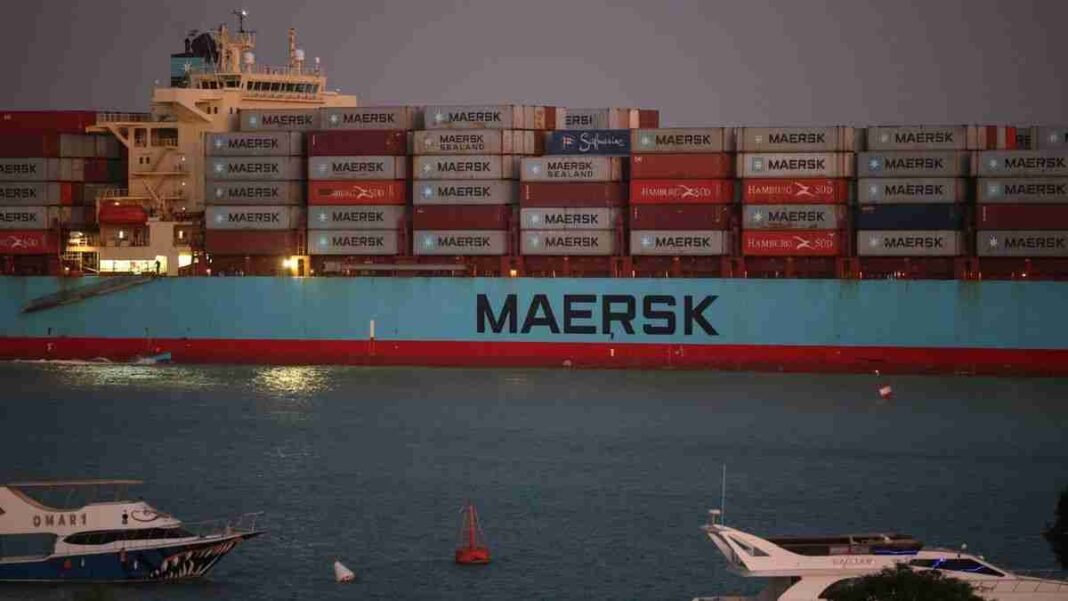
Global shipping networks are facing serious disruption as escalating security risks in the Red Sea and surrounding Middle Eastern waters force major cargo carriers to reroute vessels and suspend operations on key trade routes. The situation is creating significant shipping delays across Europe, raising freight costs and threatening global supply chains that rely on the region’s critical maritime corridors.
The Red Sea serves as one of the most important maritime gateways for global trade, connecting Asia to Europe through the Suez Canal. Under normal circumstances, thousands of cargo vessels travel through the Bab el-Mandeb Strait and the Red Sea each year before reaching European ports. However, renewed security threats and military tensions in the region have forced shipping companies to reconsider this route.
Major shipping companies including Maersk, Hapag-Lloyd, and CMA CGM have announced that they are suspending or reducing voyages through the Suez Canal and surrounding waterways. Instead, many vessels are being rerouted around the Cape of Good Hope at the southern tip of Africa, a much longer journey that adds considerable time and cost to international shipping operations.
This diversion significantly increases travel distances. Ships traveling between Asia and Europe must now sail thousands of additional nautical miles, extending transit times by more than a week in many cases. The longer journey also leads to higher fuel consumption, increased shipping costs, and more pressure on global logistics networks.
The crisis has intensified due to rising geopolitical tensions in the Middle East. Recent attacks on cargo vessels and oil tankers have raised concerns about the safety of commercial shipping routes. Explosive sea drones and missile strikes targeting ships have heightened fears among shipping companies and insurers, prompting many carriers to avoid the region entirely.
At the same time, the conflict has also affected energy shipping. Several oil tankers have been attacked or forced to alter their routes, contributing to rising global oil prices and increasing uncertainty in energy markets. Analysts warn that disruptions in maritime energy transportation could have a cascading impact on international trade and manufacturing industries.
Shipping firms are now implementing emergency measures to maintain supply chain continuity. Some companies have introduced new surcharges to compensate for higher fuel costs and longer routes. Others have suspended cargo bookings to certain ports in the Middle East due to security concerns, further tightening global shipping capacity.
European importers are among the hardest hit by the disruptions. Many goods manufactured in Asia — including electronics, machinery, clothing, and consumer products — normally pass through the Suez Canal before reaching European markets. With ships now taking longer routes, delays are being reported at several major ports across the continent.
Logistics companies have warned that the disruption could create shortages of certain goods if the crisis continues. Some exporters have already reported rising freight costs, longer delivery times, and increased insurance premiums for shipments traveling through high-risk maritime zones.
The Red Sea crisis is not entirely new. Since late 2023, attacks on commercial vessels in the region have repeatedly disrupted maritime traffic and forced companies to reconsider the safety of the route. At times, more than half of commercial cargo shipments have been diverted away from the Red Sea to avoid the threat of attacks.
Governments and international organizations are now working to improve maritime security in the region. Several naval missions have been deployed to escort commercial vessels and monitor potential threats along the shipping corridor. Despite these efforts, uncertainty remains high as geopolitical tensions continue to escalate.
For the global economy, the stakes are significant. The Red Sea and Suez Canal route carries roughly 12 percent of global trade, making it one of the most strategically important shipping lanes in the world. Any prolonged disruption could have far-reaching consequences for international trade, energy markets, and economic stability.
As shipping companies continue to adjust routes and governments seek to stabilize the region, businesses and consumers around the world are closely watching developments in the Red Sea crisis. The coming weeks may determine whether global shipping networks can return to normal or face an extended period of costly delays.
